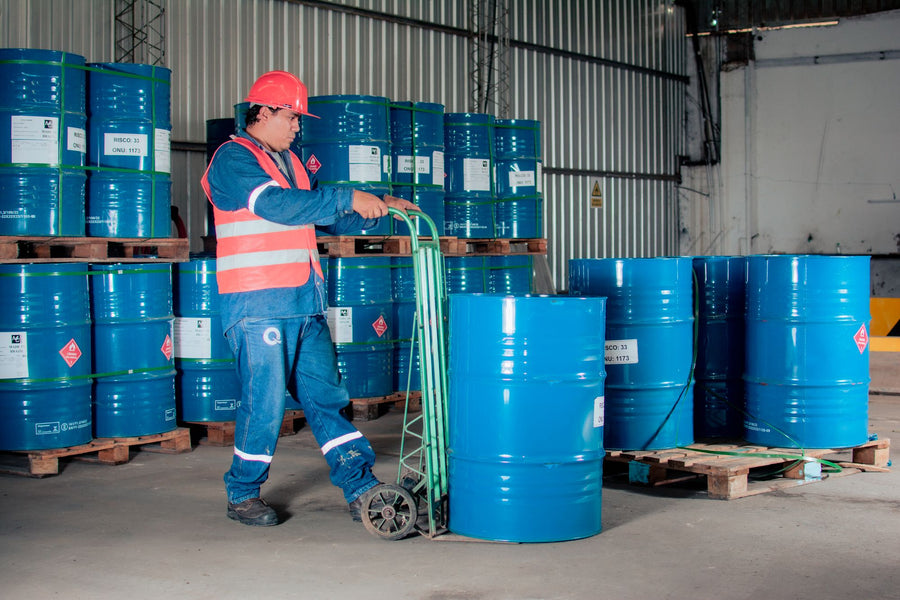
Body stressing, meaning muscle strain from lifting, carrying and handling, made up 34.5% of serious workers' compensation claims in 2023–24, more than any other cause, according to Safe Work Australia. A scissor lift table takes a lot of that lifting out of the job. The load goes on low and comes up to a comfortable working height, so nobody has to bend and lift it.
Capacity
Rate the table for the heaviest load you'll put on it, including any pallet, tote or fixture. Ours go from a 100 kg stainless-top table to a 2,000 kg electric table. For boxes, parts and tools, the 300 kg and 500 kg manual tables cover most jobs. Above that there are 700, 750 and 1,000 kg manual tables.
Platform size
The load should sit on the platform without hanging over the edge. Both the 300 kg and 500 kg manual tables have an 850 × 500 mm platform, which is plenty for most boxes and parts. For bulky items, the 500 kg large table is 1,600 × 810 mm. For doors, panels and sheet, the 1,000 kg table is 2,035 mm long.
Lift range
Look at both numbers: how low the table goes and how high it gets. A single scissor table like the 500 kg manual runs from 285 to 880 mm, about shin height to bench height. For more height, a double scissor table has two scissor sets stacked on top of each other. The 350 kg double scissor reaches 1,300 mm on a 910 × 500 mm platform.
If loads start on the floor or arrive on wheels, the lowered height matters just as much. The 1,000 kg electric table closes down to 82 mm and has a ramp, so a pallet jack or trolley can be wheeled straight on. For smaller items, the manual platform lifter starts at 10 mm and lifts 340 kg to 1,350 mm.
Manual or electric?
Manual tables lift with a foot pump and lower with a quick-release, so there's no power to run and nothing to charge. They suit occasional lifts and tables that move around. If someone lifts at the same workstation all day, the pumping gets old quickly, and electric is worth the extra cost.
- The 500 kg electric table has a 1,010 × 520 mm top and lifts from 440 to 1,025 mm. It makes a good feeding table for an assembly line.
- The 350 kg electric double scissor gives the same 1,300 mm reach as the manual version without the pumping, on a sealed, maintenance-free battery.
- The 1,000 kg electric table runs on single-phase power with a remote pendant and lifts in about 18 seconds.
- The 2,000 kg electric table needs three-phase power and suits heavy, fixed workstations. Check you have three-phase where it's going.
Special cases
- Food, medical and lab areas: stainless steel tops on the 100 kg, 350 kg and 450 kg tables resist corrosion and wipe clean.
- Building sites and yards: the rough terrain table has 200 mm castors with spring shock absorbers. Lower the load before you roll it over rough ground.
- Unloading pallets layer by layer: a pallet leveller rises as each layer comes off, so the top of the stack stays at the same height. It works on springs, with no hydraulics or power.
Lifting whole pallets onto racking is a job for a stacker rather than a lift table; see pallet jack or pallet stacker. Everything else is in our scissor lift table range.