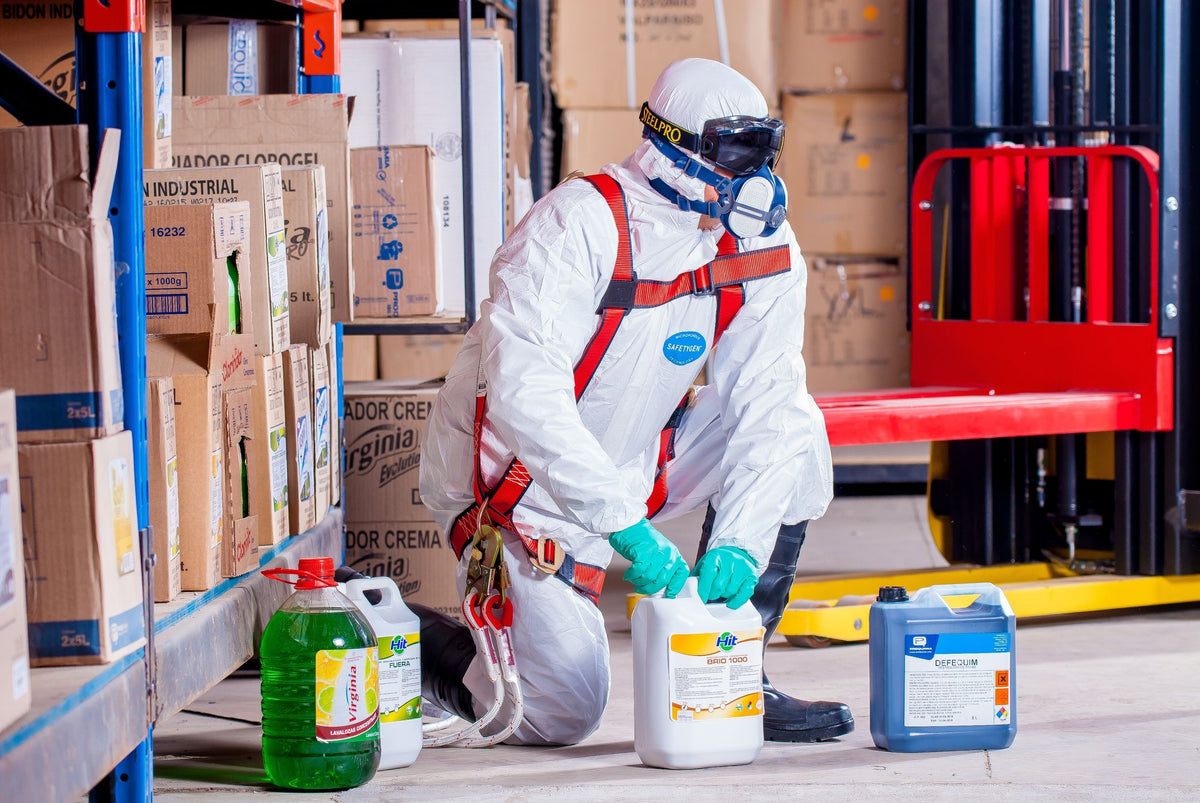
Class 3 is the dangerous goods class for flammable liquids: petrol, solvents, thinners, methylated spirits, acetone, and many solvent-based paints and adhesives. Many of them give off enough vapour at room temperature to ignite from a spark. A flammable liquids cabinet keeps them in one place, behind double walls and closed doors, away from the rest of the workshop.
Work out how much you store
List every flammable container on site and add up the sizes. Count each container at its full size, even if it's half empty, because a cabinet's capacity is the total container volume it's rated to hold. For example, four 20 L drums of solvent and ten 4 L tins of paint come to 120 L. That fits the 160 L cabinet with room to grow.
Our cabinets
- The 100 L cabinet is the smallest and lowest, at 935 mm wide, 620 mm deep and 770 mm high. It has two doors, one adjustable shelf, a bunded base and an earthing point.
- The 160 L cabinet is 1,100 mm wide but only 460 mm deep, so it sits slim against a wall. It's 1,295 mm high and has flash-arrestor vents.
- The 250 L cabinet is full height at 1,825 mm, and 1,100 mm wide by 500 mm deep, with three adjustable shelves and a bunded base.
All three are double-walled and built to AS 1940:2017, the Australian standard for the storage and handling of flammable and combustible liquids.
Where to put it
- Well away from ignition sources such as welding, grinding, open flames, heaters and switchboards.
- Clear of exits and escape routes.
- On a level floor, close to where the liquids are used, so containers aren't carried across the site.
Keep the doors shut when you're not getting something out, and wipe up any spill in the base straight away.
What stays out
Oxidisers, corrosives and anything else that reacts with flammable liquids should be stored separately. Gas cylinders have their own storage rules too. If you're not sure about a product, check its safety data sheet (SDS), which lists its dangerous goods class and what it shouldn't be stored with.
Check the rules for your site
What you need depends on how much you store and which state you're in. Larger quantities can bring extra obligations, such as placarding. Your state's work health and safety regulator can tell you what applies.
Decanting from 205 L drums? The drum handling guide covers tilters and stands. The cabinets themselves are in our safety and dangerous goods storage range.