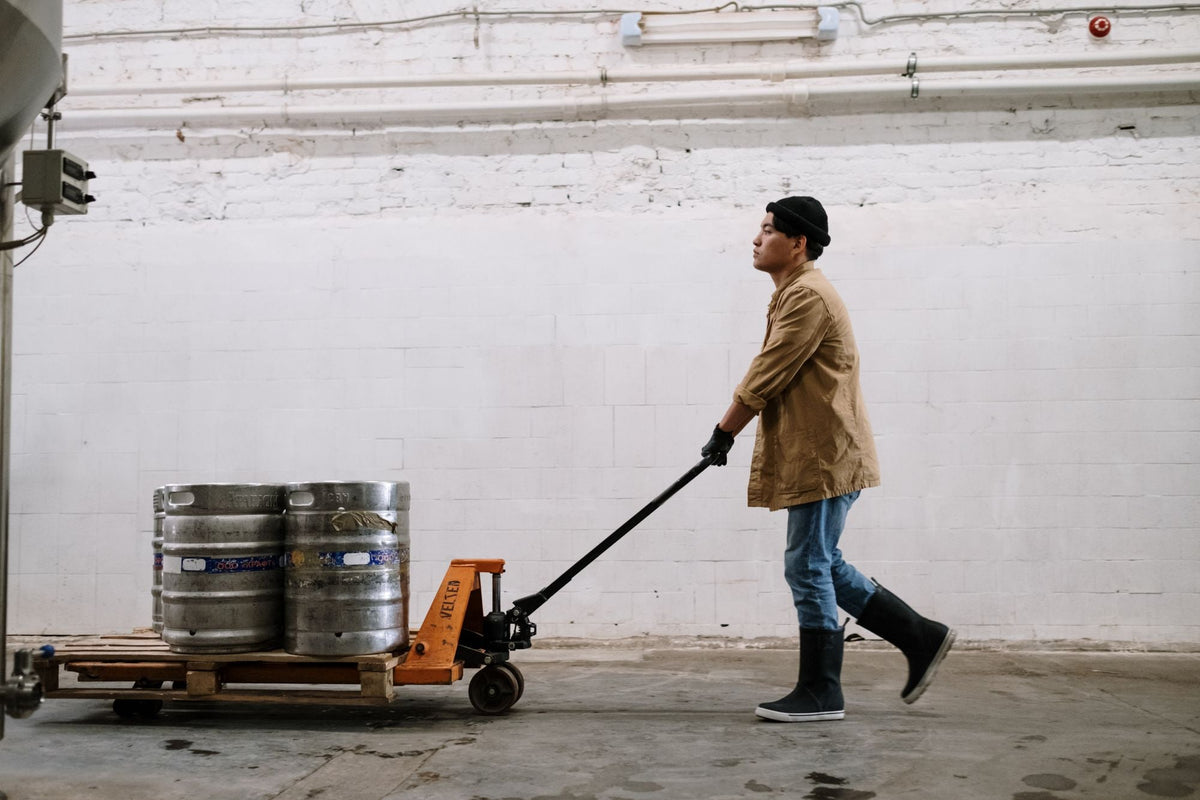
Both kinds move pallets at floor level and lift them to about the same height. What changes is who does the work. With a manual jack, the operator pumps the handle to lift and pulls the load along. With an electric jack, a battery drives the wheels and the operator steers. On our heavy-duty models the battery lifts the forks as well.
When manual is the right call
A manual jack makes sense if:
- you move a handful of pallets a day
- the runs are short, like truck to bay or bay to dispatch
- the floor is flat and smooth
- you'd rather not have another battery to look after
There isn't much to go wrong on one. Ours have sealed hydraulic pumps and a slow-lowering valve, and the 2,500 kg manual jack is rated higher than any of our electric models.
When electric pays off
The real cost of a manual jack is the operator's effort. Pulling a heavy pallet across a small warehouse a few times a day is no problem. Doing it all shift on a big site is how people end up sore, slow or injured. Electric is worth a look when:
- pallets move for most of the shift, or the runs are long
- there's a ramp or a slope on the route
- loads are regularly over a tonne
The electric models
| Model | Capacity | Battery | Forks (length × width) |
|---|---|---|---|
| Economic electric | 2,000 kg | 48 V lithium, replaceable | 1,220 × 680 mm |
| Heavy duty 1,500 kg | 1,500 kg | 24 V lithium, replaceable | 1,150 × 685 mm |
| Heavy duty 2,000 kg | 2,000 kg | 48 V lithium | 1,150 × 685 mm |
The economic model has the longest forks and an enclosed foot guard with an emergency switch. The 1,500 kg model is the lightest at 123 kg, and its tiller adjusts from 700 to 1,160 mm. The heavy-duty pair travel at about walking pace, 4.6 to 5.2 km/h.
Batteries
All three run on lithium batteries. There's no acid to top up, and you can charge them in a break instead of waiting on a full overnight charge. The economic and 1,500 kg models have replaceable batteries, so a site running two shifts can keep a spare on the charger and swap it over.
Ramps and slopes
Both heavy-duty models list gradeability of up to 16%. Treat that as the best case: spec sheets usually give a lower figure for a loaded jack. If your route has a ramp, tell us the slope and your heaviest pallet and we'll check it before you buy.
If a manual jack has to stop on a slope or a truck bed, the hand brake pallet jack has a brake so it doesn't roll away when you let go.
If pallets also need to go up onto racking, read pallet jack or pallet stacker first. Otherwise, compare every model in our pallet jack range.